
|
General Recipes
Sweet/Desert Tapas Indian/Thai Food |
Recipes /
Chili Lime Baked SalmonCopied from Fox and Briar with only minor changes. Please visit the original recipe and click some ad links to show appreciation. While you're doing that, you'll understand why I've reluctantly make a copy here. I mean, thirteen page downs to get to the ingredients? I don't have time for that; I have to make dinner. Have I violated Meghan McMorrow's intellectual property rights by copying her recipe? Actually, no. For details, refer to the Recipes and Food main page. But I don't feel great about it. Oh, well.
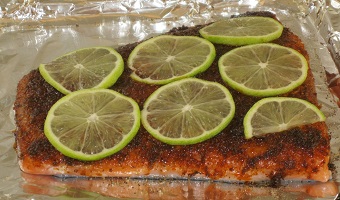 Preheat the oven to something in the range 350 to 400°F, depending on how you are accustomed to baking salmon. Zest the lime. I do this with a microplane, but there are other methods. Mix the zest with the chili powder, smoked paprika and garlic powder. Then stir in just enough olive oil to make a smooth paste that will be easy to spread on the fish. If you add more oil than is necessary, it will just run off, which is no big deal, I suppose. On a baking sheet of some sort, put a piece of aluminum foil large enough for the salmon and turn up the edges to contain the juices and make for easy cleanup. Pat the salmon dry with a paper towel and put it on the foil skin side down. Season it with ground black pepper and salt to your taste (I use plenty of pepper but no salt at all). Slather the zest / spice paste onto the fish, spreading it out evenly with the back of the spoon. Try to get some on the edges. Cut thin slices from the middle part of the zested lime and spread them on top. This looks pretty good at this point, so if you're entertaining you can leave it out where your guests will "accidentally" catch a glimpse (see photograph at right). About 15 minutes before you want to eat, put the salmon in the oven. As with all fish, the cooking time is critical. You probably have your own methods of figuring out when fish is "done" and perhaps your own ideas of what "done" means. The USDA wants you to cook fish to an internal temperature of 145°F (63°C), but chefs and most foodies would consider that overcooked. A better initial goal would be 135°F (57°C). Some people aim for 130°F (54°C) with a 5 minute rest after removing from the oven. You may be able to judge by seeing if the salmon flakes easily with a fork. What I do is to insert a thin metal skewer, such as a turkey lacer, into the thick part of the fish for ten seconds and then take it out and put it across my lower lip. If the fish it done, it will feel comfortably warm. If it's not warm, continue cooking. If it's hot, you've been punished for your mistake because it's overdone. For a family meal you can divide up the salmon and serve it on plates. For guests, you'll want to take it to the table on a platter. It slides easily enough off the skin, so you can present it whole with appropriate utensils or break it into portions in the kitchen. The cooked lime slices make a good garnish and you can add something green or whatever you want. Remember the lime? You made slices of the middle part, but if you didn't use the ends in cocktails you can now squeeze them over the fish. 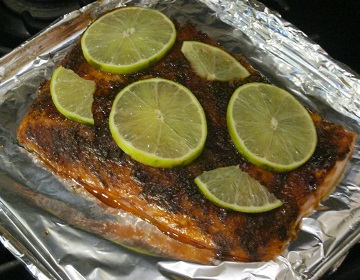 More on the "skewer method"I've been criticized for advocating the "skewer method" of judging when fish is cooked without stating when the test should first be applied. Well, that's kind-of the point of the skewer method. Whatever the thickness of the fish or the exact oven temperature or how well you preheated it, etc., you always get the results you prefer after you learn to use the method. But here's a photo, at right, of 1.2 pounds of salmon that is just over an inch thick at the thickest part. This reached my notion of perfection after 13 minutes in my oven set at 375°F and fully pre-heated. For more or less fish, thicker or thinner, a hotter or cooler oven and for a different idea of how fish should be cooked, you'll just have to make adjustments. Or, you could eat over- or under-cooked fish. There's no downside to testing early. The time out of the oven will be compensated for by the method you're using to decide when cooking is complete. You may be worried about when to start the vegetables. I suppose I have no answer that is consistent with what I'm suggesting. You'll just have to gain experience. It should be possible to hold either the fish or the vegetables in a warm oven for a couple of minutes. |