Terminology Is Boring - Just Get On With It!
Well, no, sorry. I've not found a standard way of referring to the various parts of a Sudoku puzzle (although I haven't tried terribly hard). What I refer to as a "Box", others refer to as a "square". Other people use the word "square" for what I call a "Cell". So I've established my own, very strict, terminology, which I will write up for you to read if you want to. If you don't, then if you can't understand what I'm saying you've only yourself to blame.
If I've found some kind of consensus (for example, "Grid"), then I've gone along with it. If a word is used to mean different things ("square") I've tried to avoid it. When I use a term for which I've define a specific meaning, I set it off in the text with an upper-case initial letter and italic font, like this : Grid.
My terminology is not inconsistent with what is presented on Wikipedia. If you look there, be aware that further down the page I think there are clues to advanced solution strategies that I have avoided reading, my goal being to only use things I have figured out myself.
Puzzle Geometry
- A Cell is a small square with a narrow outline that will contain a single number (other names : square, box).
- The Grid is the arrangement of eighty-one Cells into a nine-by-nine array.
- Row refers to nine Cells that are side-by-side, horizontally across the Grid. There are nine Rows.
- Column refers to nine Cells that are one-on-top-of-the-other, vertically down the Grid. There are nine Columns.
- In addition to Rows and Columns, the Grid is divided by heavy outlines into nine Boxes (other names for a Box : block, region, square). These are three-by-three arrays of Cells placed three across the Grid and three up-and-down.
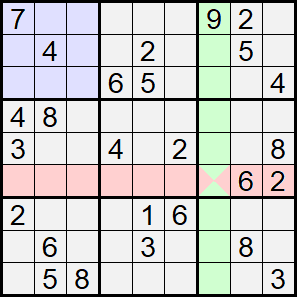
- Rows, Columns and Boxes are collectively referred to as Groups. This is important in order to keep descriptions of the rules and solution strategies reasonably compact, so please remember this. Group means a Row, a Column or a Box. O.K.? A moment's thought reveals that every Cell is a member of three Groups — one Row, one Column and one Box. The example†, above right, illustrates a Row with a pale red background color, a Column with green and a Box with blue. Have I mentioned that each of these is a Group? And that there are nine of each, for a total of twenty-seven Groups?
Numbers, Givens and Solutions
- The term Number refers to a decimal digit in the range 1 to 9, inclusive. In Sudoku, this is only a symbol; its value has no significance whatsoever. Numbers could be replaced with letters of the alphabet (any alphabet), emoticons, pictures of fruit or any set of nine distinct symbols. Decimal digits are a good choice simply because they are so familiar.
- Numbers are placed in Cells for one of two purposes. The first is to establish a starting point from which an attempt at solving the puzzle can begin. In this context, the Number is a Given (other names: clue).
- Solving a Sudoku puzzle involves figuring out what Numbers belong in the Cells not occupied by Givens. For a correctly constructed puzzle, there will only be one possibility. When a Number is placed in a Cell during this process, it is a Solution.
- I always use the word Enter when referring to the placement of a Number in a Cell, whether as a Given or as a Solution.
- A Known (or a Known Cell) is a Cell with a Number in it, either a Given or a Solution.
- An unKnown (or an unKnown Cell) is a Cell without a Number in it; what belongs there is yet to be figured out and Entered.
† The puzzle used as an example appeared in the Boston Globe newspaper on Thursday, November 10th, 2022. It is rated by the Globe as “more difficult”.