
|
Introduction Solving Puzzles |
Sudoku /
Rules of Sudoku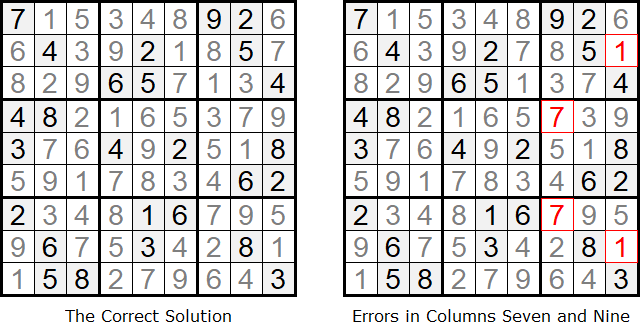 There's Really Only One RuleWikipedia claims to have "compactly stated" the "One Rule" of Sudoku as "Each digit appears once in each group". Unfortunately, the article fails to say what is meant by "digit". The following is, admittedly, less compact but is at least complete: In every Group (Row, Column and Box), there must be exactly one Cell containing each of the Numbers from 1 to 9, inclusive. Consequences of That RuleEvery Group has nine Cells. We are given nine Numbers. We can use each Number in only one Cell. So, if we examine a Group in a correctly solved puzzle, we will find that no Number appears in more than one Cell. This consequence, or, if you will, reformulation, of the rule, is often more useful during the early stages of solving a puzzle. The rule in its original form, above, is useful later on and when checking your solution for correctness. Checking Your SolutionIf you're a careful worker it isn't really necessary to check your work. You paid full attention to the rules as you placed each Solution in its Cell. Sources of puzzles (newspapers, books, Web sites) generally provide a solution and you can compare this to your result. It is always possible to test that the rule is obeyed by looking for 1, 2, 3 ... 8, 9 in each of the 27 Groups in turn. It is necessary to check all groups in this way. As the incorrect puzzle, above right, shows†, errors can be isolated to one Group type, in this case Columns. If you'd checked all the Boxes and then all the Rows, found them correct and then assumed the Columns would be correct too, you'd have been † The puzzle used as an example appeared in the Boston Globe newspaper on Thursday, November 10th, 2022. It is rated by the Globe as “more difficult”.
|