
|
Projects
Processes
Power Tools
Resources |
Bench Grinder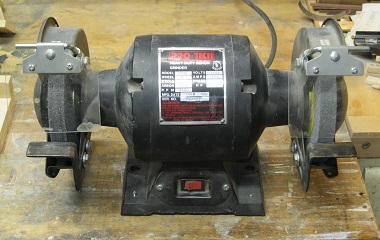 I have a ProTech "Heavy Duty" bench grinder which I bought decades ago to sharpen things like lawnmower blades and masonry chisels. The label gives the date of manufacture as 1989, the speed as 3,500 r.p.m. and the power as ½ horsepower. It uses 6" diameter, ¾" wide grinding wheels with an ½" arbor (the spindle isn't long enough to take a wider wheel). It came with dark grey aluminum oxide wheels, 36 grit on the left and 60 grit (marked A60Q) on the right. The coarse wheel is now in bad shape but the fine wheel is pretty good. Home Depot carry PowerTec brand grinding wheels in 80, 100 and 150 grits for $18.97. They also sell silicon carbide wheels, but that doesn't seem the best choice for tool steel. Norton make a White Aluminum Oxide Grinding Wheel that they claim keeps the tool cooler. These are available from (for example) SharpeningSupplies.com.
 Sharpening Wood ChiselsThe grinder's tool rest is attached to the sheet metal safety shield that partially encloses the wheel. Two very short 5/16" coarse thread bolts pass though a long slot in the rest so that it can slide in and out. However, there is no mechanism to allow it to tilt, so you have to perch the tool you're sharpening against the edge of the rest, guess the angle and maintain it as best you can. I have made a guide for grinding the 25° primary bevel on wood chisels. It is a block of wood that slides over the tool rest and provides a flat surface against which to press the tool. The bevel will, of course, be concave, but it doesn't take much effort to flatten it out with a diamond water stone. Sharpening Turning (Lathe) ToolsMy Home-Made Skew ChiselI made my skew chisel from an old metal file. The bench grinder played a major part in that, removing the file teeth and establishing the cutting edge on what was originally nothing more than a flat tool-steel bar. To get the 40° bevel angle, i.e. a 20° half-angle, I used blue painter's tape to fix a spacer strip across the top of the 25° guide that I use for wood chisels. To get the 70° angle of the cutting edge to the tool axis, I drew lines on the guide at a 20° offset from straight up-and-down. Then I maintain that angle by eye. As with wood chisels, the concavity is removed by honing on a flat diamond water stone and, since I have made a jig for that, errors in the geometry will also be corrected. This all worked really well. As I'm just not figuring the skew chisel out, I don't think I'll have to take it back to the bench grinder very often. The SkewchigougeThe upper (concave) face of the skewchigouge is ground with a radius (as far as I can tell) of 2 inches (or a little bit over). To regrind that, I would need to swap out a wheel for one 4 inches in diameter (or 4½"). I cannot find one that has an arbor hole. So, the bench grinder is no help here. I've adapted a drum sander that mounts in a drill. The lower (bevel) face appears to have been ground on a flat abrasive surface, swinging the tool around some axis to get a curve. I've tried to free-hand this but regretted it. I'm working on a jig for future use. |