
|
Projects
Processes
Power Tools
Resources |
Recipe for my First Bud Vase  This is a record of how I make a bud vase according to my first design. I modeled this vase on a larger one that I found on the Web by copying the proportions into SketchUp and eyeballing the rendered result. I had no idea whether this would be a practical project, but it looked interesting. I completed the first piece on February 12, 2021. I used scraps of wood I had no other planned use for. This exercise validated the procedure, but made it clear that my skill as a turner was not really up to this kind of work. If I make more vases to this design, using wood species chosen for appearance rather than disposability, I need to improve my turning in a couple of areas. The process of making the vase divides cleanly into two steps. The first takes a lot of calendar time waiting for the glue to dry. The second takes just a couple of hours. Read on for more details. This design allows for actual use as a bud vase by the insertion of a vase tube purchased from Craft Supplies USA, Item # 104415. The "small" tube is needed, not the "large". Although the dimensions are given as ¾" diameter by 4¾" long, the tube slides easily into a hole drilled with a ¾" forstner bit. I measured the actual diameter of one tube as 0.705", widening to 0.902" at the flare. The total length was 4.87", 0.11" of which was the flare, leaving 4.76" from the bottom edge of the flare to the very bottom of the rounded end. To avoid the need for boring to a depth of nearly five inches, I left the glue-up of the segmented section open in the center so that only the top section needs to be drilled. I measured the inside diameter of the tube at 0.613", so the wall thickness is 0.046" (1.17 mm). 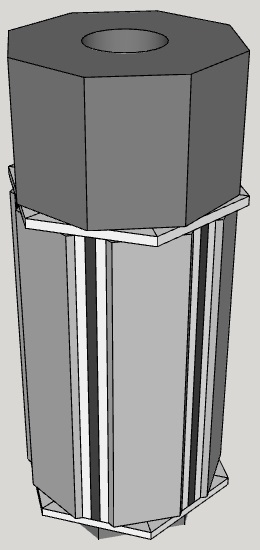 Cutting and Gluing Up the SegmentsThe vase is divided vertically into five (very unequal) sections. Refer to the SketchUp image at right. The top and base sections are made from the "secondary wood", which was cherry in my first try but might be redheart if I make this again. Above the base and below the top section are thin layers of "light accent wood", which was maple in my first try. In between these is a complex segmented glue up of the "primary wood", "light accent wood" and "dark accent wood". In my first try, the primary wood was goncalo alves, and the dark accent wood was African padauk. The following paragraphs describe each section in excruciating detail, the point being to discuss design choices and increase the change of finding usable wood to hand.
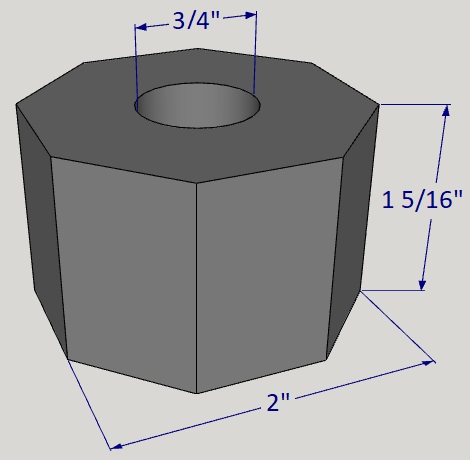 Top Section (Secondary Wood)The top section should be a chunk sawn from a 2" square turning blank. Glue lines would mess up the appearance, so this can't really be assembled from segments. The grain runs vertically, parallel to the axis of the vase. (The cherry that I used for my first try had grain that was substantially off the axis and I had some tearout as a result.) The glue joint to the accent layer below is, of course, end grain, but this seems to be fine. Maybe it would be a good idea to avoid woods that are known to be difficult to glue (cherry is easy to glue). The height of this section should be 1 5/16". If it is taller, it will just have to be trimmed off later. This might be a good idea if the top surface can't be made perpendicular to the vase axis. Facing it off on the lathe will correct this. The intended diameter of this part of the vase is 2", so if this section cannot be aligned perfectly (the usual situation) it needs to be a little larger to compensate. The figure at right shows the corners sawn off to make it octagonal, which saves some work on the lathe, but this is not essential. The figure also shows a ¾" hole bored in the centre, which is not correct. Assuming that the tailstock center will be engaged in this part of the glue-up, boring the hole should be left until after turning is complete.
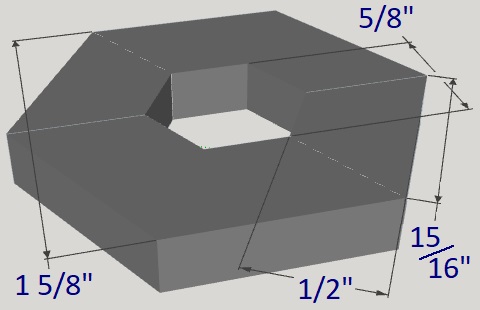 Base Section (Secondary Wood)The purpose of the base is to make the vase more stable (the one I found on the Web just got narrower all the way to the bottom and looked rather tippy). It could be a slice of a turning blank, just like the top, with grain along the vase axis. For my first try I was using up scraps wherever possible so instead I made this from six segments. The segments are clearly visible but don't detract from the appearance because the base is only ¼" thick. As shown in the diagram at right, the base can be glued-up from six pieces cut from ½" wide material with a length of 15/16" along the outer edge. The resulting 5/8" diameter hole in the middle, which is visible on the bottom of the finished piece, will clear the glass tube because the round end only just comes down this low in the vase. As the vase is 1½" in diameter at the base, the 1 5/8" width provides only a little extra for alignment, so you might prefer 1" at the edge.
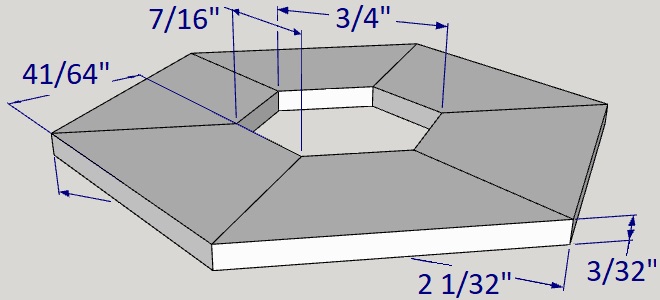 Thin Accent LayersAgain, the thin layers of the light accent wood could be slices of a turning blank but for my first try I made them in six segments from scraps. This is visible but doesn't detract from the appearance. It's possible that the face-grain glue joints to these sections strengthen the vase, but I don't really think so. I glued two of them up separately but it might have been quicker to glue up a fatter section and then slice it in half. Also, I should have run the whole layers through the drum sander after the glue dried, not the strips before sawing and gluing them. The dimensions shown in the diagram at right are the bare minimum for a two-inch diameter vase and probably won't be the ones you actually use. The layer just below the top section has to be large enough around the outside that it doesn't limit the turned diameter, even accounting for misalignment during glue-up, and 2 1/32" is cutting it a bit fine. On the other hand, the hole in the middle can be quite a bit larger than ¾" because the glass tube is held in position by the drilled hole in the top section. So it makes sense to increase either or both the width of the segments, shown as 41/64", and the inside length of the segments, shown as 7/16". Note than if the hole for the tube doesn't line up, you can just continue drilling through it. The layer just above the base section has quite different considerations. It does not have to be so large, as the vase has a smaller finished diameter at this point. Alignment of the hole in the middle is less of an issue as the glass tube at this point is narrowing towards the round bottom. However, a different issue arises, which is that the small diameter means that there isn't a lot of wood to hold everything together. So, keep the the hole as small as you dare for maximum strength.
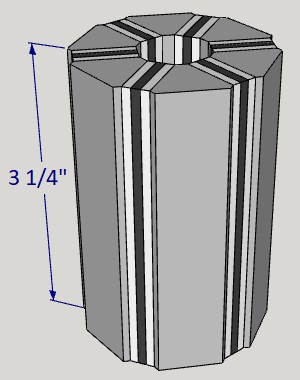 Segmented SectionThe largest part of the vase is made from six angled segments of the primary wood interleaved with flat pieces which are a sandwich of the light and dark accent woods. The design allows for all of the parts to be sawn from ¾" nominal thickness dimensional lumber. The finished height of this section is 3¼", so everything should be a little longer than this so that the excess can be trimmed after gluing up. 33/8" should be fine, but if you're worried about alignment during glue-up you should maybe go for 3½". 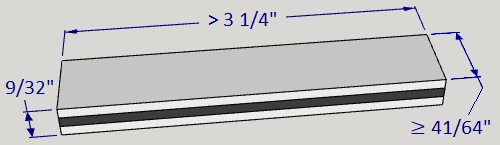
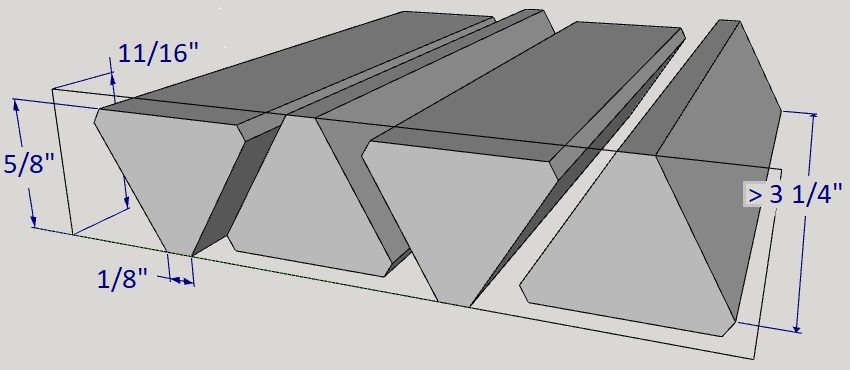
In addition to the angle of 30° and the length, which should be around 3 3/8", just like the accent pieces, important dimensions are the radial thickness, shown in the diagram at right as 5/8", and the circumferential width on the inside of the glue-up, shown in the diagram as 1/8". These are both the absolute minimum and will require perfect alignment of the glue-up. It will be more practical to increase one or both dimensions, but which depends on circumstances. If the radial thickness is comfortably above 5/8", the only reason to increase the circumferential width would be to allow more clearance for the glass tube. If the radial thickness is on the small side, then the only way to add margin to the diameter is to increase the circumferential width. However, don't go crazy with this or you'll end up with not enough material around the bottom of the vase and it may become fragile, perhaps falling apart on the lathe.
Turning the Vase
|