|
Woodworking
Projects
Processes
Power Tools
Resources
Back to Wiki Home
edit this SideBar
|
Recipe for RISD Alumna Coaster Set, Designed Using SketchUp
(Go Back to the Coasters Main Page)
WORK IN PROGRESS !!!
Coaster Ingredients (Makes Four Coasters)
Instructions for Coasters
Referring to the photograph,
Holder Ingredients (Makes One Holder)
- One piece of walnut, ¾" thick and 3" square or slightly larger if possible.
- One piece of padauk, 3/16" to 1/4" thick and 3" square or slightly larger if possible.
- One small piece of tiger maple, ¼" thick by about ½" wide by 1" long.
- Two thin strips of wenge, 1/16" thick by ¼" wide by 1" long, as for the coasters.
- Urethane (or similar) finish, as for the coasters.
- Pressure sensitive cork, as for the coasters.
Instructions for Holder
- Resaw the walnut into a thicker square for the bottom and a thinner square for the top. I aimed for the top to be about half the thickness of the bottom. To reduce the amount of wood lost to the saw kerf, I used a Japanese pull saw instead of my table saw. This has a kerf of 0.7mm (about 1/32"), which is one third of the kerf of my table saw blade. I knew that the cut would not be as straight as with the table saw and that I would have to remove more material at the drum sander to get pieces with flat and parallel sides, so I didn't expect to gain much. I was just interested in how this would come out. (Actually, I was also wondering whether to make a band saw from my drill press for both a really thin kerf and a well-controlled cut.) The measured thickness of the ¾" nominal piece I started with was 0.757". After processing through the drum sander until flat and parallel, the two pieces I ended up with measured 0.236" and 0.459". This totals 0.695", so I lost 0.062", which, by coincidence, is almost exactly 1/16". So I gained at least 1/32", which, admittedly, isn't much.
- Glue the padauk and walnut together in a sandwich, clamp and allow to set up. If the pieces are only 3" square, line them up carefully to minimize the need to trim the result. If you've allowed some spare wood, you can be a bit more sloppy. In either event, make sure that, after the glue is dry, you'll have an edge to use as a reference to trim the others. In other words, don't end up with something that doesn't have at least one exactly straight edge. The easiest way to do this is to have (at least) one component piece larger than 3", make sure it protrudes slightly beyond the other two pieces and wipe off the glue. I started with a piece of padauk a little more than 2" wide. Rather than find more, I cut it into strips, marked on the walnut where the slots would be and glued the padauk only where it was needed. This worked OK, but was more trouble than it was really worth.
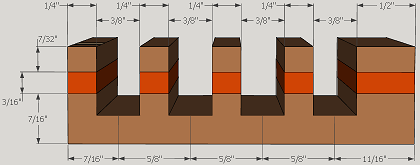
- Measure the combined width of the maple piece and the flanking wenge strips. If the sizes are as given in Ingredients, above, this will be 5/8". Check the thickness of the maple and the width of the wenge, which you want to be ¼". If it is less, this must be your new goal for the thickness of the first rib of the holder and the depth of the cut you're about to make.
- Using the table saw, trim the walnut-and-padauk block to final size, either 3" square or as close to this as possible. Decide which face will be the front of the holder (obviously edge grain, not end grain). Decide on the position of the maple and wenge insert; for example, I chose 9/16" from the right hand side. Starting at this point, make a cut ¼" deep (or as determined from the dimensions of the maple and wenge pieces) from top to bottom of the front side (as should be obvious from the photograph). Make further overlapping cuts until you reach the combined width of the maple and wenge. This can be done on a table saw, on a router table or with a hand saw and a chisel. Some kind of jig will be needed to allow a power tool to make these cuts safely. I used my table saw and cross-cut sled. Because I don't have a blade with a flat top grind, I ended up with a ragged surface at the bottom of the cut. This was easy to clean up with a chisel.
- Glue the maple and wenge pieces into the slot that you have just cut. They should be on the loose side without glue because when you apply glue they will swell and the fit will be tighter. If they are 1" long they can protrude at the top and the bottom and this will be dealt with later. Press them fully into the slot. It doesn't matter if they stick out a bit, but if they are below the front surface you're going to have to trim that back and reduce the depth of the holder.
- Allow the glue to dry. Trim any maple and wenge that protrudes beyond the bottom surface of the holder with a chisel, flush-cut saw or by careful sanding (or a bit of each). Trim the top more carefully, as this will not be covered by the cork base. Using the bottom surface as a reference, you can use a table saw or thickness (drum) sander. Finally, trim the front face with a table saw so that the walnut, maple and wenge are flush.
-
- Sand
-
- Apply urethane finish as for the coasters.
- Apply 1/16" cork sheet to the bottom as for the coasters. I was running out of cork sheet and used two strips, each about ¾" wide, one along the front and one along the back. I reasoned that people would pick up the holder and inspect its underside much less often than the coasters themselves.
(Go Back to the Coasters Main Page)
|

